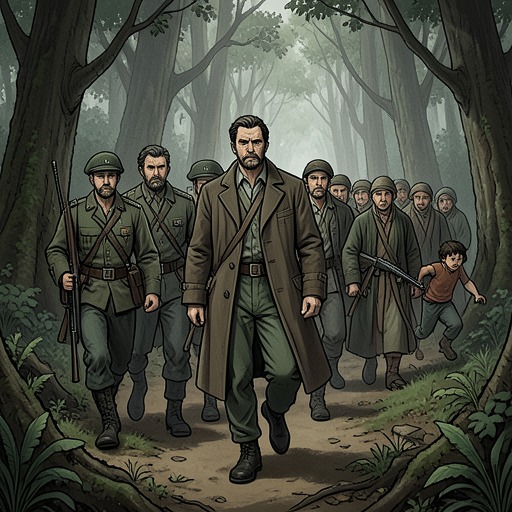
Army of Sven
SCOTTISH ROMANCE: My Sinful Surrender to a Highlander Werewolf (Scottish Werewolf Pregnancy Romance) (Historical Medieval Shape Shifter Paranormal Science Fiction Short Stories)The Army of Sven is the principal instrument of Sven’s expansion across the surrounding kingdoms and countryside. It is not merely a force of conquest: through village burnings, executions, forced allegiance, and the pursuit of Zuzulla, it makes military power personal, administrative, and intimate. Its actions devastate the communities that sustain the Highlanders, provoke a mercenary countermeasure from the Kingdom of Kigom, and ultimately draw the army away from Sven’s wider campaign.
Formation and Political Purpose
The army operates within Sven’s conquest of the Kingdom of Berigord and his continuing pressure into the Kingdom of Kigom. Kigom’s king recognizes that his own forces cannot defeat Sven’s army directly, but he also knows that the Highlanders can work as mercenaries and are willing to do whatever is necessary to complete an assignment. Because Sven values his daughter Zuzulla, Kigom’s king hires Carden’s werewolf clan to take her, hoping that Sven’s attention will shift from conquest to recovery. The Army of Sven is therefore the reason a military conflict becomes a hostage crisis: its success makes Sven powerful, but its dependence on Sven’s personal priorities gives his enemies a point of leverage.
Sven’s stated strategic objective is larger than the seizure of a single kingdom. He wants to become king of all the surrounding lands, and he understands that the Highlanders stand between him and that ambition. In his calculation, they could provoke a revolt among the people and lead an army against him; with popular support, their forces could defeat his own. The army’s campaign against the Highlanders is consequently both territorial and preventative. Sven seeks not only to occupy land but to destroy the community capable of turning resistance into a broader uprising.
Methods of Conquest
The Army of Sven announces its intentions through exemplary destruction. It attacks a small village known to be frequented by the Highlanders, burns its shacks and cottages, and takes whatever remains. Sven deliberately chooses the location to send a message that his soldiers know where the Highlanders gather and that he is coming for them. His best warriors are assigned to plans for killing all the Highlanders, and the campaign is presented as one that will continue until the entire group is dead.
The village is poor, but it is economically important to the Highlander clan. Its inhabitants sell the furs and meat from the clan’s kills, and the proceeds allow the Highlanders to equip themselves with the best weapons. The village also provides one of the few places where the clan feels accepted. Burning it therefore attacks more than buildings: it cuts into the clan’s supply system, threatens its military capacity, and destroys a social refuge. The army’s method is effective because it targets the material and emotional infrastructure of resistance at the same time.
Its treatment of civilians reveals the moral code that distinguishes Sven’s soldiers from Carden’s clan. The soldiers kill the men of a village or allow strong survivors to join the army. Women and children are left exposed to the soldiers’ violence; women who refuse to submit may be killed, while the old are also considered useless and are killed. Survival is conditional on pledging allegiance to Sven. The army thus converts conquest into a system of forced incorporation, in which submission is the only recognized form of protection.
The narrative contrasts this conduct with the werewolves’ need to kill humans for food. Carden’s clan sometimes requires human hearts to survive, but it avoids killing innocents and chooses the worst criminals when feeding is unavoidable. By comparison, Sven’s soldiers are described as taking pleasure in killing people who resist allegiance. The difference does not make the Highlanders harmless, but it establishes that the Army of Sven’s defining cruelty lies in its deliberate enjoyment of domination rather than in necessity alone.
The Village Raid and Highlander Resistance
Carden returns toward the village after seeing smoke while traveling with members of his clan. In werewolf form, they can reach the settlement within minutes, running far faster than any human. They approach cautiously, checking the bushes and ruined cottages for soldiers before entering. The army has withdrawn by the time they arrive, but its presence remains in the smoke, the burned structures, and the bodies left behind.
Inside a cottage that has not completely collapsed, Carden finds a woman under thirty lying naked and dead. He covers her with a blanket taken from the floor, attempting to restore a small measure of dignity after the army’s violence. The gesture sharply reframes the raid: the soldiers’ absence does not end the scene, because the survivors and rescuers must move through the physical evidence of what the army has done. Carden’s anger also turns the destruction into a personal summons to retaliate against Sven.
The clan finds a young girl hiding behind a table. She is no more than sixteen and is well known among the younger Highlanders. She takes Carden’s hand and embraces him while sobbing, and he realizes that the clan will have to take her back and change her into a werewolf. Even rescue is morally uncertain: Carden wonders whether she understands what her future will mean and whether death at the hands of Sven’s army might have been less terrible. The army’s attack thus forces the Highlanders to preserve life through a transformation that itself removes the girl from ordinary human existence.
The raid also creates an absence that the soldiers do not understand. When Zuzulla fails to return, the guards search the woods and find the remains of her dress, shredded as if by an animal but without blood. They fear both Sven’s punishment for losing his daughter and the possibility that disappearing entirely will bring an even more relentless hunt. They decide that lifelong imprisonment would be preferable to returning without her or being hunted down after abandoning the search. Their fear shows that the army disciplines its own members through the same merciless power it directs against conquered people.
Recall and Strategic Reversal
Sven is leaving to meet Zuzulla when a guard brings him the torn dress. His anger changes the army’s mission immediately. He orders the soldiers home and commands them to comb the woods until his daughter is found, declaring that nothing else matters. The order reveals the private attachment hidden beneath Sven’s public image as a conqueror, but it also exposes the army’s structural weakness: its movements are governed by the ruler’s personal priorities.
The recall produces exactly the opportunity the Kingdom of Kigom intended to create. While the Army of Sven searches the woods, Sven’s enemies gain time to build their own forces and prepare an attack. The army remains formidable, but its concentration has been redirected from conquest to recovery. Carden and his clan do not defeat it in open battle; instead, the abduction of Zuzulla makes Sven redeploy his strength and turns his military system against its own strategic program.
Sven never finds his daughter. While his soldiers search, Carden returns to the cave with two rabbits and berries to share with Zuzulla, makes a small fire, and settles beside her. The contrast is decisive: the army searches through the forest as though military force can restore control, while Carden’s quiet act of providing food confirms that Zuzulla has entered the Highlanders’ sphere. The Army of Sven’s apparent reach ends at the cave, where its authority is replaced by captivity, protection, and the unresolved danger of a werewolf clan’s intervention.
Narrative Significance
The Army of Sven embodies conquest as a cycle that destroys the very conditions required for stable rule. Its violence is intended to prevent revolt, yet the burning of the Highlanders’ village intensifies Carden’s resolve and helps justify the clan’s resistance. Its treatment of civilians is meant to enforce allegiance, yet it makes Sven’s rule appear indistinguishable from terror. Its pursuit of Zuzulla is intended to recover the king’s daughter, yet the search withdraws soldiers from the wider front and gives Kigom the time it needs.
As an organization, the army also supplies the book’s central contrast between power and control. It can burn a village, kill those who refuse allegiance, and command an entire countryside, but it cannot prevent a single disappearance from reorganizing its priorities. The force that seems capable of conquering kingdoms is rendered vulnerable by a daughter, a torn dress, and an enemy who understands that Sven’s emotional attachment is more exploitable than his battlefield strength.